


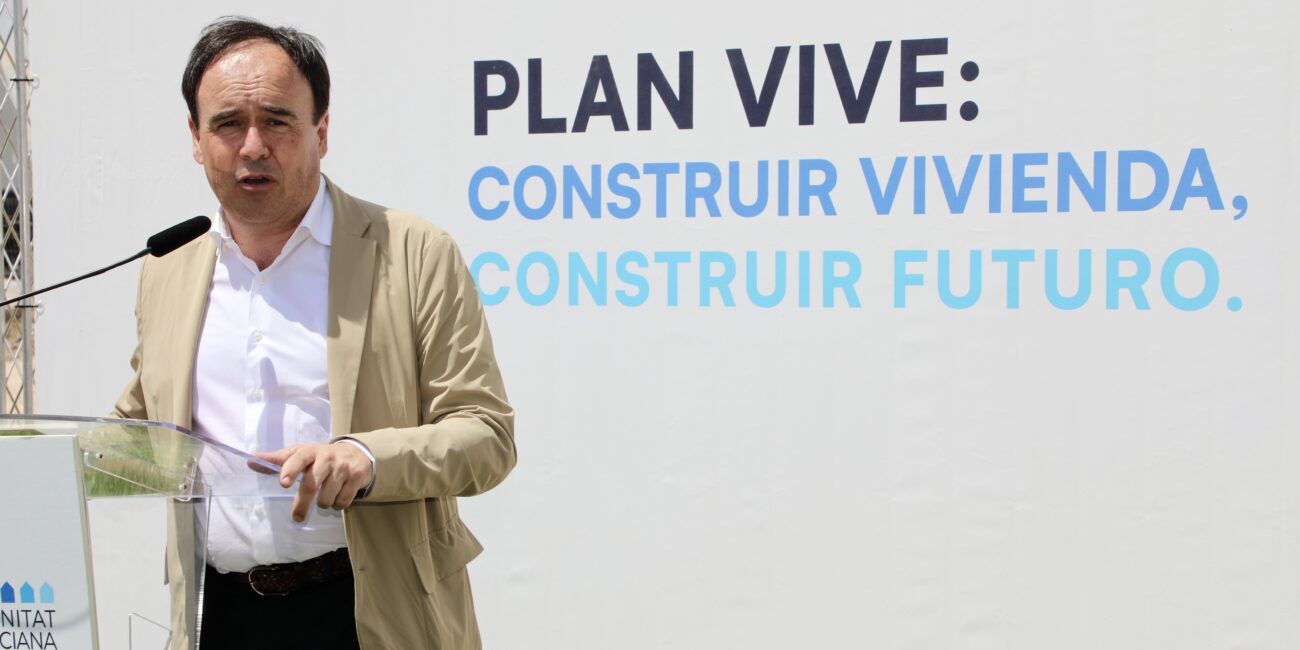
The Generalitat presented the start of the Vive Plan in Torrevieja on Friday, 12th June, a project that was announced two years ago in July 2024. The mayor of the municipality, Eduardo Dolón, was the first to join this regional project, as highlighted by the president of the Consell, Juanfran Pérez Llorca, who assured that the 822 public subsidised housing units (VPP) planned in the town will be a reality in 2028.

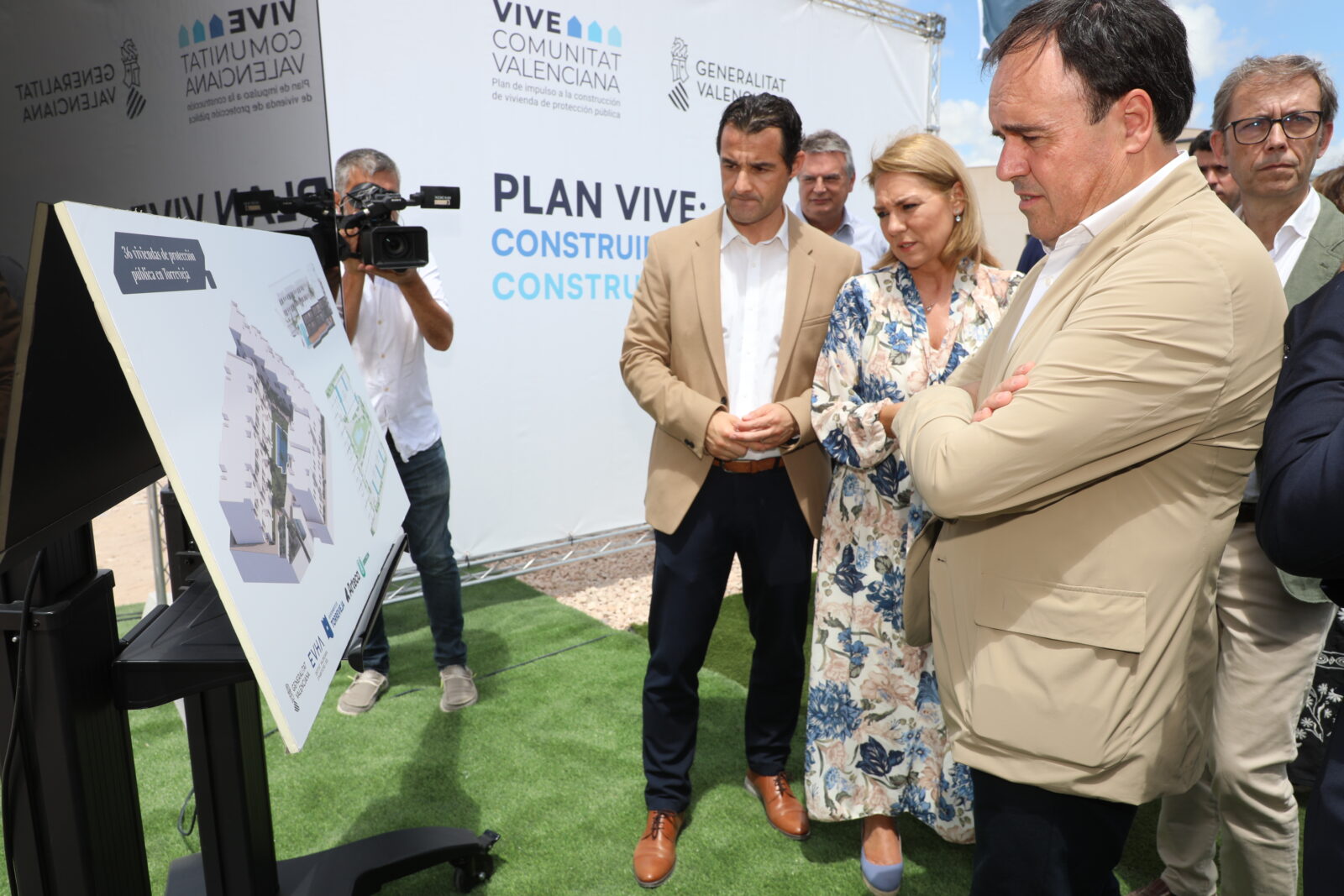
Although the majority of the properties are located in La Hoya, the chosen site was the La Manguilla plot in La Mata, where construction of 36 units will begin next week. The local governing board plans to approve the building licence for this development on Monday.
The works are being carried out on a total of four municipal plots located in both sectors, with an estimated investment of 100 million euro. Also participating in the event were the First Vice President and Minister of Housing, Employment, Youth and Equality, Susana Camarero, as well as representatives of the construction companies awarded the contracts for these properties.
The councillor emphasized that no public housing had been built in the salt-producing city for over a decade: “Now we are announcing them not by making promises or commitments, but by actually starting them.” At the same time, he assured that the remaining projects, referring to La Hoya, “will be released in quick succession next week” to obtain the necessary licences, with the developers confident they can begin construction in September. It should be noted that the plots were provisionally allocated in July of last year and definitively in October 2025, but they are still pending the completion of the major urban development project affecting the area.
Projects
José Antonio Ropero, architect for Urdecon, the company developing this project in the Matera district, explained that the building, situated on a 3,608-square-metre plot, will be U-shaped and open towards the sea, with a landscaped interior designed for community interaction. Specifically, the building will feature 18 one-bedroom apartments, 10 two-bedroom apartments, and eight three-bedroom apartments, along with a total of 53 parking spaces and 36 storage units, emphasising quality, sustainability, and energy efficiency. “This is one of the most sought-after plots in the municipality, with sea views,” stated the mayor.
All of them will be marketed once they obtain the corresponding provisional qualification of protected housing, a procedure expected in the coming weeks. The sale prices will be subject to the limits established by the protected housing decree approved by the Valencian Government, thus ensuring that these homes maintain their affordability for citizens.
On behalf of Abala Infraestructuras (Hozono Global Group), María Córdoba outlined the characteristics of the 220 apartments with up to four bedrooms spread across three blocks, with common areas, swimming pools and children’s play areas, on a surface of 9,745 square metres on plot R-17 of sector 20 of La Hoya.
José Antonio Monasterio, from Livanto Promociones, explained that the company will develop 566 homes on two plots of land in La Hoya, of which 114 (20%) will be handed over to the City Council. As compensation for the value of the municipal land ceded for these developments, “the land swap will allow the City Council to receive 182 homes for its municipal housing stock,” Dolón later added.
Requirements
The Torrevieja City Council has also initiated the public participation procedure for the development of a new municipal ordinance that will regulate the scoring criteria applicable to homes that become part of the municipal heritage.
This regulation will incorporate criteria linked to roots and territorial connection with the municipality, valuing aspects such as the length of time registered or the development of work activity in Torrevieja, with the aim of facilitating access to housing for those who maintain a stable relationship with the city.
With the aim of offering maximum transparency throughout the entire process, the City Council will make available to citizens a specific website where all information relating to promotions, requirements, deadlines, award procedures and news related to the Vive Plan will be updated.
More housing
During his speech, the head of the Consell highlighted the promotion of public housing in the Valencian Community “for the people who need it most and thinking especially about young people”, compared to zero social housing in the two previous legislatures, thanks to the implementation of the Vive Plan and public-private collaboration.
In fact, he insisted, in just three years the Valencian Government has promoted the implementation of almost 6,500 properties in the three provinces since the beginning of this legislature, of which 4,833 correspond to publicly protected housing and public-private partnerships, in addition to 1,585 privately developed properties.
In this regard, he thanked the 320 municipalities, “of all political stripes,” that have joined the Vive Plan for “believing in this project and wanting to solve the housing problem, which will only be solved by building more homes,” he asserted, while adding the need to draft new urban planning legislation that gives more autonomy to local administrations, eliminates bureaucracy, and lowers taxes.
Greater transparency
Pérez Llorca also emphasised that “the Generalitat is correcting the mistakes of the past.” In this regard, he pointed out that “today we allocate housing in a more transparent and objective way,” through a portal where anyone can register and access the information instantly.
Thus, he recalled that the Generalitat has recovered “the principles of equality, objectivity and competition for the allocation of VPP that the previous Government had eliminated in its decree and which specifies the obligation of notaries to verify the visa of the buyer.”
Furthermore, he added that there is a commitment to greater publicity, transparency, control and security, with the mandatory publication of promotions on the Generalitat’s website, the electronic registration of applications and the creation of a collegiate, technical and independent Evaluation Commission to assess the requirements in the visas of buyers, among other new measures implemented by the Consell.
He also added that territorial ties have been introduced as a key criterion for access to public housing, prioritizing those who want to continue living in their municipality.
The president also emphasised that the Vive Plan includes a 40% reservation of publicly subsidised housing for young people and alluded to other measures implemented by the Valencian Executive such as the reduction of the Property Transfer Tax (ITP) for young people and vulnerable people, and the guarantee programme of the Institut Valencià de Finances (IVF) to facilitate the acquisition of homes for young people and which allows financing up to 100% of the property.
Claims
Finally, the president invited Sánchez’s government to join the Vive Plan, because “we have found a good formula for building homes in the Valencian Community.”
In his opinion, “if we had genuine collaboration and if the Spanish Government joined this project, we could be much more ambitious and talk not of 10,000, but of 20,000 publicly subsidised housing units,” also urging that they take the example of the Valencian Community in tax cuts, since “30% of the cost of a home is just taxes,” he concluded.
Other Articles