

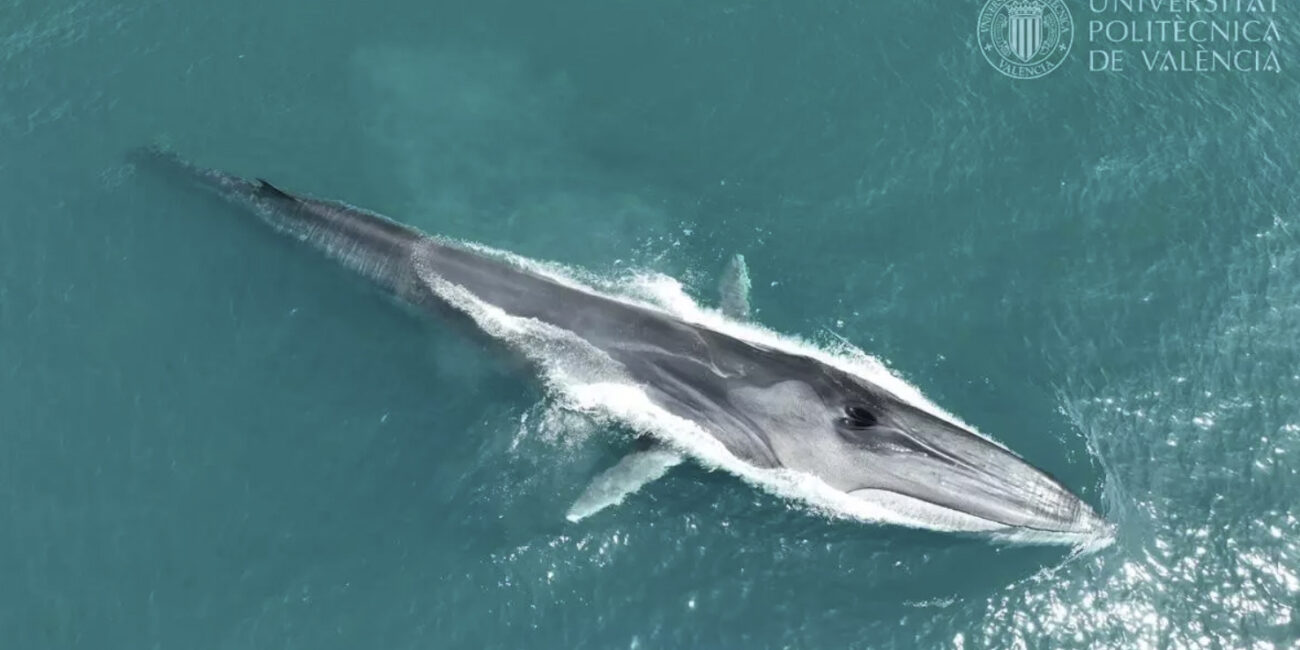
A total of 127 fin whales, the second-largest animal on the planet, have been spotted off the coast of Denia and the Marina Alta region. The research campaign started on 25th May and concluded on Monday 6th July, carried out by a team from the Universitat Politecnica de Valencia (UPV).

The fin whale is the second-largest animal on earth, behind only the blue whale. It is one of the most frequent baleen whales in the Mediterranean, and Denia has become a premier observation point for these massive marine mammals in recent years.
The data acquired by the UPV team in 2026 has helped improve knowledge of the fin whale population, their migratory movements every spring off the Marina Alta coast, and their behaviour, with the aim of contributing to their conservation. From a scientific perspective, this is crucial work, as the species is classified as “endangered” by the International Union for Conservation of Nature (IUCN).
The UPV team used a drone to photo-identify more than 100 fin whales, adding new individuals to the species catalogue. Additionally, researchers managed to obtain six blood samples using non-invasive techniques. A drone equipped with a Petri dish captured residues from the whale’s blow hole when it surfaced to breathe. These samples will allow scientists to determine the sex and hormonal status of the whales. The drone also detected several females with calves during active migration, providing important data regarding the recovery of the species.
“This year’s campaign has undoubtedly been an absolute success: more fin whales than ever, more photo-identifications than ever, and more calves detected than in any other campaign,” highlighted Victor Gallego, a researcher at the Institute of Animal Science and Technology at the UPV.
As in previous years, the UPV team operated with two researchers at sea and two on land. The marine team consisted of Eduardo Belda, from the Research Institute for Integrated Coastal Zone Management (IGIC), and Victor Gallego. Both spent more than 30 days at sea in a small boat, accumulating 250 hours of navigation, tracking the fin whales from late May to early July.
“The conservation of the fin whale in the Mediterranean goes beyond protecting a threatened species, as it plays a key role in nutrient circulation and in mitigating climate change,” Belda emphasised.
Meanwhile, the land-based team consisted of Xavi Gimenez and Maria Giovanna. Positioned at Cape Sant Antoni, their work was fundamental for spotting the whales, since 90 per cent of sightings occur from land. Once spotted, the team at sea directly monitors the animal to determine its heading, speed, numbers, photo identification, and sample collection.
“Observing fin whales from land is an incredible feeling. Detecting the blow from the cliffs is the first step for the research team to study the animal. The Marina Alta is probably the best point in Europe for watching whales from the coast, as you can enjoy a globally unique observation with just a pair of binoculars,” Xavi and Maria noted.
The UPV team also highlighted the collaboration of several entities during this campaign’s sampling, noting that it would have been impossible to monitor so many fin whales this season without them. These included Marina el Portet (Denia), Martin Germann, Hector Villar, Ondara Red Cross, the general sub-directorate of Terrestrial and Marine Biodiversity of MITECO, the Marine Surveillance Service (GVA), the Wildlife Service and Natura 2000 Network of the GVA, Wewhale, and all the spotters who assisted with whale detection efforts.